
Running RNA-Seq Analysis
To run the tool, go to:
Tools | RNA-Seq and Small RNA Analysis ( ) | RNA-Seq Tools (
 ) | RNA-Seq Analysis (
 )
The tool takes as input one or more sequence lists ( ) containing single reads, paired reads, or a combination of both.
The following table lists recommendations for which options to use in various common situations. The tool's options are described in detail below.
| Situation | Recommendation |
|---|---|
| Eukaryotic reference with gene and transcript annotations | Select Genome annotated with genes and transcripts. |
| Prokaryotic reference | Select Genome annotated with genes only. |
| Genes are tightly packed or organized in operons | Select One reference sequence per transcript. For paired reads, also check Count paired reads as two. |
| Transcripts produced by de novo assembly | Select One reference sequence per transcript. |
| Strand-specific protocol | Select Forward or Reverse, matching the protocol. |
| 3' sequencing protocol | Select 3' sequencing. |
| Protocol generating chimeric reads | Uncheck Count paired reads as two and Ignore broken pairs. |
| Sample differs considerably from the reference, or transcript annotations are incomplete | Uncheck Ignore broken pairs. |
Selecting references
The following options can be configured in the Reference settings dialog (figure 34.33):
- One of the following reference types can be selected:
- Genome annotated with genes and transcripts. When selected, a Reference sequence, Gene track, and mRNA track must be provided. This option is recommended for references with transcript annotations, including eukaryotic references where splicing must be taken into account.
Genes and transcripts are linked by matching the ID values in the Gene track with the Parent values in the mRNA track.
- Genome annotated with genes only. When selected, a Reference sequence and Gene track must be provided. This option is recommended for references without transcript annotations, such as prokaryotic references where transcripts are not spliced.
- One reference sequence per transcript. When selected, only the Reference sequence must be provided. This option can be used, for example, for references produced by de novo assembly of RNA-Seq data, or when genes are tightly packed or organized in operons.
Depending on the selected reference type, the following elements must be provided:
- Reference sequence. A sequence track (
 ) with the reference genome, or one or more sequences (
 ) () containing the transcript references.
- Gene track. An annotation track (
 ) with the gene annotations.
- mRNA track. An annotation track () with the transcript annotations.
Annotated reference genomes can be obtained by:
- Downloading using Reference Data Manager.
- Importing fasta and gff/gtf files as tracks.
- Importing GenBank or EMBL files, or downloading sequences from GenBank, and converting them to tracks.
- Genome annotated with genes and transcripts. When selected, a Reference sequence, Gene track, and mRNA track must be provided. This option is recommended for references with transcript annotations, including eukaryotic references where splicing must be taken into account.
- Spike-in controls can be configured as follows:
- Do not use spike-in controls. When selected, spike-in controls are not used.
- Use spike-in controls. When selected, a Spike-in controls element (
 ) must be provided. See Import RNA spike-in controls for information about importing spike-in control files.
- Do not use spike-in controls. When selected, spike-in controls are not used.
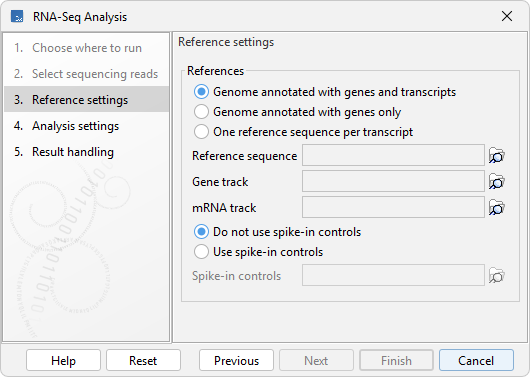
Figure 34.33: Reference settings for RNA-Seq Analysis.
Configuring the analysis
The following options can be configured in the Analysis settings dialog (figure 34.34):
- Maximum number of hits for a read. Reads that can map equally well to more distinct locations than this number are not mapped. A value of 10 or more is recommended. A value that is too low can remove evidence for an expressed gene. See Read mapping and expression quantification for details.
- Strand settings. The expected orientation of the reads relative to the transcripts from which they originate can be configured as follows:
- Both. Reads are mapped in the same and reverse orientation as the transcript from which they originate.
- Forward. Reads are mapped in the same orientation as the transcript from which they originate.
- Reverse. Reads are mapped in the reverse orientation as the transcript from which they originate.
When a strand-specific protocol was used, select the corresponding setting. This supports assignment of reads to the appropriate gene when overlapping genes are located on different strands. When Both is not selected, only pairs in forward-reverse orientation are used, and mate pairs are not supported.
- Library type settings. The expected distribution of reads along the transcripts can be configured as follows:
- Bulk. Reads are expected to be uniformly distributed across the full transcript length.
- 3' sequencing. Reads are expected to be biased towards the 3' end of transcripts. Report quality control is tailored for low-input 3' sequencing applications.
- Count paired reads as two. When unchecked, an intact pair is counted as one fragment. When checked, each mapped read in an intact pair is counted, and an intact pair contributes two counts. Mapped members of broken pairs are also counted, and Ignore broken pairs is disabled.
- Ignore broken pairs. When checked, neither member of a broken pair is counted towards the expression of a gene or transcript. When unchecked, mapped members of broken pairs are counted. Single reads are always counted as one.
Broken pairs can indicate that transcripts are not represented correctly in the reference or that the data contain errors, so intact pairs generally give more reliable expression values. Counting mapped members of broken pairs can be useful when the sample differs considerably from the reference or when transcript annotations are incomplete. For protocols that generate chimeric reads, we recommend unchecking both Count paired reads as two and Ignore broken pairs. Note that when Count paired reads as two is checked or Ignore broken pairs is unchecked, the counts no longer correspond to the number of sequenced fragments.
- Expression value. The value stored in the Expression value column of the expression tracks and used in the track view visualization.
- Total counts. The value in the Total exon reads column for gene-level expression tracks, and in the Total transcript reads column for transcript-level expression tracks.
- Unique counts. The value in the Unique exon reads column for gene-level expression tracks, and in the Unique transcript reads column for transcript-level expression tracks.
- TPM. Transcripts Per Million.
- RPKM. Reads Per Kilobase of exon model per Million mapped reads.
See Output from RNA-Seq Analysis and Expression measures for details.
- Calculate expression for genes without transcripts. When checked, genes without annotated transcripts are treated as one exon spanning the full gene. When unchecked, no expression values are reported for these genes.
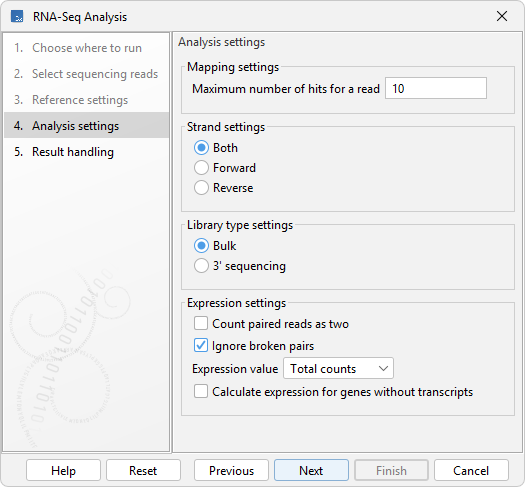
Figure 34.34: Analysis settings for RNA-Seq Analysis.