
Low Frequency Variant Detection
Low Frequency Variant Detection is suitable for analysis of samples of mixed tissue types (such as cancer samples) in which variants with low frequency are likely to be present, as well as for samples for which the ploidy is unknown or not well defined. The tool also calls more abundant variants, and can be used for analysis of samples with ploidy larger than four. Note that analysis will generally be slower than those of the other variant detection tools. In particular, it may be very slow - possibly prohibitively so - for samples with extremely high coverage or a very large number of variants (e.g. samples that differ substantially from the reference).
This tool is designed for short reads. As a result, using it with Oxford Nanopore or PacBio long reads may lead to excessive runtime and memory usage, particularly for (1) whole-genome sequencing, (2) datasets that include regions with very high coverage, or (3) when the minimum frequency is set to a low value. In addition, homopolymer errors are more prevalent in long-read sequencing, and many of these errors may be reported as variants.
Low Frequency Variant Detection relies on
- A statistical model for the analyzed sample and
- A model for the sequencing errors.
A statistical test is performed at each site to determine if the nucleotides observed in the reads at that site could be due simply to sequencing errors, or if they are significantly better explained by there being one (or more) alleles. If the latter is the case, a variant corresponding to the significant allele will be called with an estimated frequency.
The tool has one parameter (figure 32.6):
- Required Significance: this parameter determines the cut-off value for the statistical test for the variant not being due to sequencing errors. Only variants that are at least this significant will be called. The lower you set this cut-off, the fewer variants will be called.
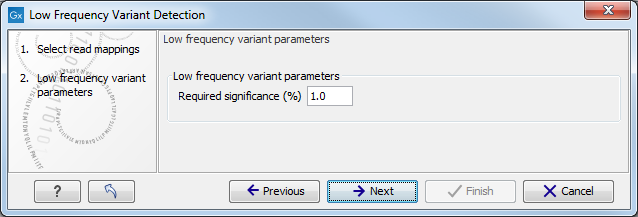
Figure 32.6: The Low Frequency Variant Detection parameters.
For a more in depth description of the tool, see Detailed descriptions).