
Alignment-based design of PCR primers
In this mode, a single primer or a pair of PCR primers are designed. CLC Genomics Workbench allows the user to design primers which will specifically amplify a group of included sequences but not amplify the remainder of the sequences, the excluded sequences. The selection boxes are used to indicate the status of a sequence, if the box is checked the sequence belongs to the included sequences, if not, it belongs to the excluded sequences. To design primers that are general for all primers in an alignment, simply add them all to the set of included sequences by checking all selection boxes. Specificity of priming is determined by criteria set by the user in the dialog box which is shown when the Calculate button is pressed (see below).
When in Standard PCR mode, different options can be chosen concerning the match of the primer to the template sequences in the included group:
- Perfect match. Specifies that the designed primers must have a perfect match to all relevant sequences in the alignment. When selected, primers will thus only be located in regions that are completely conserved within the sequences belonging to the included group.
- Allow degeneracy. Designs primers that may include ambiguity characters where heterogeneity occurs in the included template sequences. The allowed fold of degeneracy is user defined and corresponds to the number of possible primer combinations formed by a degenerate primer. Thus, if a primer covers two 4-fold degenerate sites and one 2-fold degenerate site, the total fold of degeneracy is
 and the primer will, when supplied from the manufacturer, consist of a mixture of 32 different oligonucleotides. When scoring the available primers, degenerate primers are given a score which decreases with the fold of degeneracy.
- Allow mismatches. Designs primers which are allowed a specified number of mismatches to the included template sequences. The melting temperature algorithm employed includes the latest thermodynamic parameters for calculating
 when single-base mismatches occur.
Clicking on the Calculate button will prompt the dialog shown in figure 22.14.
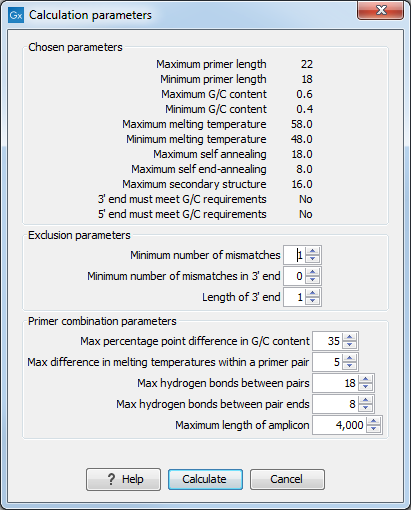
Figure 22.14: Calculation dialog shown when designing alignment-based PCR primers.
The top part of this dialog shows the single-primer parameter settings chosen in the Primer parameters palette in the Side Panel, which will be used by the design algorithm.
The central part of the dialog contains parameters pertaining to primer specificity (this is omitted if all sequences belong to the included group). Here, three parameters can be set:
- Minimum number of mismatches. The minimum number of mismatches that a primer must have against all sequences in the excluded group to ensure that it does not prime these.
- Minimum number of mismatches in 3' end. The minimum number of mismatches that a primer must have in its 3' end against all sequences in the excluded group to ensure that it does not prime these.
- Length of 3' end. The number of consecutive nucleotides to consider for mismatches in the 3' end of the primer.
The lower part of the dialog contains parameters pertaining to primer pairs (this is omitted when only designing a single primer). Here, five parameters can be set:
- Max percentage point difference in G/C content. If this is set at e.g. 5 points, a pair of primers with 45% and 50% G/C nucleotides, respectively, will be allowed, whereas a pair of primers with 45% and 51% G/C nucleotides, respectively, will not be allowed.
- Max difference in melting temperatures within a primer pair. The difference in melting temperatures (in Celsius) that primers in a pair are allowed to have.
- Max hydrogen bonds between pairs. The maximum number of hydrogen bonds allowed between the forward and reverse primer in a pair.
- Max hydrogen bonds between pair ends. The maximum number of hydrogen bonds allowed in the consecutive ends of the forward and reverse primer in a pair.
- Maximum length of amplicon. The maximum length of the PCR fragment.
The output of the design process is a table of single primers or primer pairs, as described for primer design based on single sequences (see Standard PCR output table). These primers are specific to the included sequences in the alignment according to the criteria defined for specificity. The only novelty in the table is that melting temperatures are displayed with both a maximum, a minimum and an average value to reflect that degenerate primers or primers with mismatches may have heterogeneous behavior on the different templates in the group of included sequences.