
Calculate Contamination Fraction
The Calculate Contamination Fraction ( ) tool estimates the fraction of a sample that is likely to originate from a second, contaminating genome. The tool examines a reads track at specified variant positions and identifies deviations from the variant frequencies expected in an uncontaminated sample. These deviations are used to estimate the level of contamination.
To run the tool, go to:
Tools | LightSpeed ( ) | LightSpeed Analysis Tools (
 ) | Calculate Contamination Fraction ()
The tool takes a read mapping ( ) as input. In the second wizard step (figure 17.1) you specify
- Known variants
- Variant database A set of variants whose frequencies should be considered in the estimation. See note below about a suitable set.
- Filtering
- Target regions track When specified, only variants in the target regions are considered. Recommended when using a targeted application.
- Region-level CNV track When specified, variants in the specified regions are excluded from the estimation. Recommended if CNV calls are available.
- Ignore non-specific matches When ticked, non-specifically mapped reads are ignored in the frequency calculations.
- Threshold
- Contamination threshold Threshold for determining a Yes/No sample contamination call. If the estimated contamination fraction is above the threshold the sample will be considered contaminated and the call will be Yes.
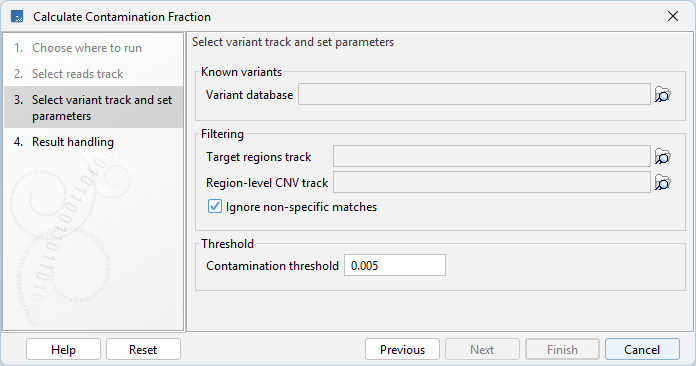
Figure 17.1: Select variant track and set parameters.
The sensitivity and reliability of contamination fraction estimates depend on two main factors. First, the amount of data available for estimation, which is determined by both the number of informative variant sites and the sequencing coverage at those sites. In general, larger numbers of variants and higher coverage yield more precise and robust estimates.
Second, the informativeness of the variant sites themselves. Germline variants with high population polymorphism are particularly useful, provided they are located in genomic regions where allele frequencies are unlikely to be influenced by factors other than contamination, such as copy number alterations or segmental duplications.
Because both factors vary between assays and sample types, the sensitivity and reliability of contamination estimates are highly application-specific. Performance should therefore be characterized empirically using controlled datasets, including uncontaminated samples and samples with known levels of contamination.
Note about the Known variants track A variant track that can be used as Known variants is available in the Reference Data Manager, see References management. This track is a subset of the 1000 Genomes variant dataset and includes only SNVs that meet the following criteria:
- Highly polymorphic across populations (allele frequency between 0.2 and 0.8 in all populations).
- Located outside low-complexity regions, segmental duplications, and HLA genes.
- Located within the high-confidence regions of HG002.
- Not located within homopolymers longer than 8 bases.
Subsections